Flying Against the Winds of Science – Culture versus Strategy Why Southwest's Culture eats USAIRWAY's Strategy I’ve been doing considerable research and development of programs for workforce motivation, engagement and the role of incentives and rewards in building a culture of performance. What I have discovered is that incentives and rewards are primitive tools of the 20th century carrot and stick approach to motivating employees performance, and at best they only affect short-term results and come with great risk. With this in mind I was fascinated to find two articles about separate companies exemplifying and employing the best and worst forms of employee motivation. The first company is one operating in the 21st century but still mired in 20th century beliefs about motivation and utilizing 20th century tools to accomplish its mission. The second has a record of consistent excellence in operating performance and employee and customer satisfaction for more than 20 years, with a focus on building and sustaining a high performing culture by utilizing a proven model of motivation that taps into the intrinsic desires of employees and customers. My interest was piqued not just because of the content of the articles; I was also interested because I am a customer of both organizations and have a personal understanding of how their approaches to workforce motivation impact my experience. And I can attest that there is a significant difference. The two companies are USAir Ways (USAir) and Southwest Airlines. I am a frequent customer of USAir – in fact, I just achieved Platinum status in their air miles program – and am an occasional user of Southwest. This is only because USAir provides better routes to my most frequent destinations. Therefore I use them out of convenience, not preference. On one particular trip I wanted to make an intermediate stop before heading to my final destination. I chose Southwest on this occasion because it had a better schedule at similar rates. The hotel I was staying at provided me a complementary copy of USA Today, which I decided would make good reading on the plane. As I was scanning the headlines, one in particular caught my eye: “US Airways makes progress.” It chronicled how the company found itself ranked low on many indicators of passenger satisfaction, such as baggage handling, and how it recently achieved top ratings compared to other “legacy carriers,” which Southwest is not. The article stated that the company had to dramatically boost performance and one key initiative it instituted to aid in this was an incentive program called Triple Play Bucks, which pays employees when the company achieves top billing in a number of categories. It went on to say that employees have received $350.00 each this year for a total of 13.1 million dollars distributed to employees. The second article, “Gary’s Greeting,” by Southwest’s CEO Gary Kelly, which appeared in the airline’s Spirit magazine, discussed the importance of corporate culture and how the company has worked diligently to keep it vibrant for more than 20 years. Kelly stated, “Your business plan is what you are, but culture is who you are,” and the article noted the significance of Southwest’s Culture Committee, which consists of employees from each major work location meeting quarterly to share ideas on how to keep their culture vibrant, meaningful and strong. The article highlighted the three qualities that define their culture: “A Warrior Spirit,” “A Servant’s Heart” and “A FunLUVing Attitude.” A statement from Southwest’s investor relations web page notes, “Southwest is one of the most honored airlines in the world known for its commitment to the triple bottom line of Performance, People and Planet.” One could be skeptical and say this is a heap of self-promotion. However, Southwest was honored by receiving an Employees’ Choice Award as one of the top 50 best places to work in 2012 – an award 150,000 companies competed for, all rated and ranked by their employees. Southwest came in 17th and the competition included companies such Google, Facebook, Nike, and Starbucks. No other airline was ranked in the top 50. Both airlines have accomplished a lot, however it appears USAir is still trapped in 20th century thinking and strategy about motivation. I am making this assertion because of the use of the Triple Pay Bucks, which is a purely extrinsic, carrot and stick tool to buy performance. This ploy is fraught with risks and is difficult to sustain. When will employees begin to complain that $350.00 isn’t enough to behave in a manner that endears customers? Will USAir be willing to up the ante if necessary? What if oil spikes because of a world crisis and the company feels the need to cut costs? These are a few of the pitfalls for pay-for-performance schemes. I have had firsthand experience working with a company that compensated employees to serve on a committee to provide an important internal service in the organization, and when the organization made a decision to reduce compensation they lost members and now cannot recruit new ones. There is another factor to consider that is identified in numerous employee engagement surveys: employees who work hard eventually come to resent co-workers and the company as a whole when slackers receive the same rewards. What is most troublesome about USAir’s strategy is that since the 1970s this type of extrinsic motivation program has been proven to be a failure. One of the pioneers in researching human and organizational motivation is Edward Deci, Ph.D Professor of Psychology at the University of Rochester. In this quote from his book Why We Do What We Do, he succinctly articulates the core issue: “When people say that money motivates, what they really mean is that money controls. And when it does, people become alienated – they give up some of their authenticity –and they push themselves to do what they think they must do. One take on the meaning of alienation is that it begins as people lose touch with their intrinsic motivation, with the vitality and excitement that all children have.” Daniel Pink, in his book Drive, states, “The problem is that most businesses haven’t caught up to this understanding of what motivates us. Too many organizations – not just companies, but governments and non-profits as well – still operate from assumptions about human potential and individual performance that are outdated, unexamined, and rooted more in folklore than science. They continue to pursue practices such as short-term incentive plans and pay-for-performance schemes in the face of mounting evidence that such measure usually don’t work and often do harm.” As many companies do, USAir took the easy way to achieve a strategy, possibly not realizing or caring about building a positive, high-performing company culture for the long term. A familiar quote goes, “Culture eats strategy for lunch,” to which I can’t help but add, “There are no free lunches.” The opportunity to build a service culture may have been lost for USAir; surely they’ve lost the opportunity to ignite the intrinsic motivation waiting to be released in their employees. It is also important to note that for some employees, programs like Triple Pay Bucks can be perceived as an insult, because it insinuates a lack of respect, concern and personal pride that they take in their job – something that management assumes they can stimulate with the metaphorical dangling carrot. Alternately, I must share one example of how I experienced Southwest’s spirited, heartened and fun-loving culture. On a 45-minute flight (air time), Southwest’s flight attendants started to take drink orders as the flight was taxiing. Once the plane reached a safe altitude they put a drink and a bag of peanuts in every passenger’s hand and did so with a smile. On a recent USAir flight of the same duration, as well as same route, a flight attendant announced after takeoff that there would be no beverage service because of the short duration. That is the absence of any kind of spirit and no amount of Triple Pay Bucks will instill it. I will continue to fly USAir because it is convenient. I don’t have high expectations; therefore I only occasionally get upset at the absence of service and caring. I look forward to opportunities when I can fly Southwest and experience what it is like to be a customer taken care of by genuinely happy, motivated employees. The Renewal Group has developed programs to assist companies in developing high-performance cultures by awakening, inspiring and empowering intrinsic motivation and human potential. Our Partners in Safety Program demonstrates how companies by utilizing intrinsic motivation concepts and tools can build high-performing safety cultures within their organizations and The Edge Program provides leaders and managers with the concepts and tools to unleash intrinsic motivation in their employees and our Relationship - Centered Leadership program assists leaders in developing the Seven Hallmarks of Leadership that build their power to inspire and influence employee engagement. Postscript: On a later flight on USAir I met a flight attendant who makes a difference not because of triple bucks, but because he is intrinsically motivated. I'll share this story on a blog soon to be posted 1 Comment Healing My Wound 07/08/2011
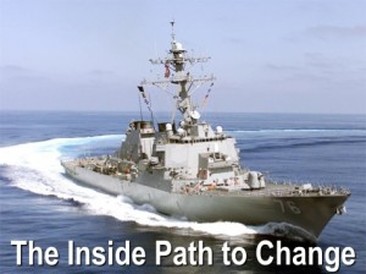
I recently reviewed a case study of a project of which I was a member of the development and delivery team. The project was designed for the US Navy Chaplain Corps at a time when they where in the midst of transformation, it was titled, Accelerating Change With Emotional Intelligence. What I didn't realize was that this project would have as much an affect on me as it did on our participants. In 1969 I graduated from college and within a few days received notification that I was required to report for my induction physical. The Vietnam War was still raging and every night the news was filled with body counts from both sides; it was a frightening and tumultuous time both for our country and for me. I was recently married and fortunate enough to have been accepted into grad school that Fall, but our country needed more and more bodies to fight the war and deferments had run out for me. Reporting for my physical, I boarded a bus in my hometown with about 30 other guys; a few were acquaintances from high school. We traveled a few hours to the induction site. The bus was very quiet; not much talk at all. Everyone was somber and seemed to be contemplating their future. Where will I be a month from now? we all wondered. We were commanded to get of the bus and line up. There had to be more than 300 boys, all there for the same reason. Guys in uniform were yelling and pushing us from one station to another. Much of the examination took place in large rooms. It was my first taste of military life. Under my arm I carried a large brown manila envelope that contained x-rays from three knee surgeries I had during my senior year of high school and first year of college, a result of playing football. Except for my knees I was in perfect health. Although my knees eventually forced me to quit playing football in college, I was still able to run and be athletic. I thought surgeries might disqualify me, but in 1969 the rumors were that only being disabled would keep you from passing. As I was standing in line I was approached by an aggressive man in uniform who yelled, “What’s in that envelope, boy!” Before I could answer he grabbed it out of my hand and left without a word. I wanted to protest, but it was obvious this was not the time or place to protest or put up a fuss; it could only lead to something I wasn’t ready to handle. My orders were simple and didn’t need to be verbalized: keep my mouth shut, follow the person in front of me and stay on the yellow line. Stop whenever I’m told and do whatever I’m commanded to do. At some point later in the day I was pulled out of line and told to report to an office at the far end of the room. I knocked on the door and a voice commanded me to come in. The person behind the desk said, “Sit down.” He asked me to identify myself and then told me to drop my pants! As I was unbuckling I noticed he had my x-rays on the desk. He then asked me to stand up on a stool, and as I did he looked at the surgical scars on both my knees. “Get down and pull your pants up. You’re through.” He put the x-rays back in the envelope and told me I was unfit for duty and to report to my station and wait for my bus to leave. I sat very still for about another hour before the contingent from my hometown finished the process. We boarded and headed home. About 30 minutes later it started to sink in. I wasn’t going to be drafted and in a few months I’d be attending classes instead of learning to survive in the jungle. I wanted to laugh and stand up and yell with relief, but didn’t because surely no one else on that bus was feeling as joyful. In fact, that ride home was one of the most difficult ninety minutes I have ever experienced in my life. It was obvious that I was the only person on that bus who knew what his fate would be. Everyone else was once again in deep contemplation. There were occasional laughs and remarks – “Can you believe what just happened?” “I’ve never been through anything like that in my life.” “Did you see that guy crying in the corner?” As soon as these words would leave someone’s lips, most knew more days like this waited ahead. The war came to an end a few years later. I graduated from grad school and took my first job; I was on my career path. Over the years I noticed that I would experience a sense of guilt and remorse about not being part of the war. I felt like I didn’t do my duty. I had escaped; I chickened out. I had hid while others took my place. In the mid-80s I moved to the Washington DC area and after work one evening I decided to visit the Vietnam War Memorial. I had heard so much about it – how it was a healing place for many. But for me it only deepened my sense of guilt about not having fulfilled my duty. I never let anyone in on these feelings and thoughts. They didn’t haunt me over the years, but they would certainly visit. And although I knew it hadn’t been my decision not to serve, that didn’t stop the guilt from returning. In 2003 I had the good fortune to work with 6 Seconds on a project for the US Navy and Marine Chaplains Corp. It was to develop a program to equip chaplains with the tools to be effective change agents. They are key influencers and resources to captains, commanders and the men and women who look to them for solace, guidance and forgiveness at sea and in battle. For over a year I worked with chaplains from Norfolk, VA to Okinawa, Japan. At first I didn’t realize why this program took on such significance for me until we presented the pilot program in Newport, RI. In the opening introductions I realized I now had my chance to redeem myself, to serve my country and to heal my wound. I would like to take this time to personally thank 6 Seconds and our team, and most of all the near-900 chaplains around the globe who invited me in and allowed me to share my story with them. We helped each other in ways that were much deeper and more important than how to become an effective agent for change and transformation. Every day they heal psychological and spiritual wounds and I’m very thankful to be one of the many they have touched. I invite you to read the case study of this project. It’s an excellent description and demonstration of how emotional intelligence can be applied to help organizations and change agents effectively implement and steward change and organizational transformation. Resources: Military chaplain: Marines in Iraq look to pastor for answers to tough questions, Christian Science Monitor Article Ministering to Soldiers, and Facing Their Struggles, NYTimes Article EQ: Case Study, 6Seconds The Leadership Journey 02/26/2011
“I will take it! I will take the ring to Mordor. Though I do not know the way.” These words of authenticity, spoken from the heart as well as the head, came from an unexpected and unlikely source; they were the words of the Hobbit Frodo. His words of courage and vulnerability broke through the clamor of egos and refocuses attention on the true purpose for the gathering: what must be done with the all-powerful ring and who will lead us in this quest. I couldn’t help seeing this scene in my mind as I was reading a Harvard Business Review blog post by Linda Hill and Kent Lineback titled, The Words Many Managers Are Afraid To Say. In this scene from the film, Fellowship of the Ring, a fictional group of men with positional power and important titles, such as king, are swinging and clashing their verbal swords over whose point of view is correct. They are so blinded by power and ego they are unable to implement one of the most important tenets of leadership: creating a way for people to contribute toward making something extraordinary happen. In Hill and Lineback’s blog they ask, “When was the last time you said words like these to the people who work for you?” “I don’t know.” “I was wrong.” “I’m sorry.” “Would you help me?” “What do you think?” “What would you do?” “Could you explain this to me? I’m not sure I get it.” Why are leaders so reluctant to say these words of influence and power? Why are we afraid of these words, not just from a leadership perspective, but also in all of our relationships? We expect our Hobbits, “little people”, to say them, but as we mature and become adults and leaders we tremble at the thought that they might escape our lips for fear that we may be perceived as vulnerable, incapable, or not smart enough to do our job. We know how powerful the emotion of fear is. What if in a paradoxical way, fear actually makes us more powerful? Think about it from this perspective. If I overcome my egos’ fear of being perceived as vulnerable, might other people recognize this and see me as being brave and authentic instead of weak? Frodo stands up and accepts the mantle of leadership when he says, “I will take the ring.” But by adding, “though I don’t know the way,” he creates the opportunity for everyone else to contribute to something extraordinary! It is at that courageous moment that he is offered the talents, skills and commitments from all the others to form the Fellowship of the Ring. The 2011 Survey of Employee Engagement, by BlessingWhite, highlights the desire of employees to know the person behind the title. “Managers are not necessarily doing the things that matter most. The actions that correlate the most with high engagement are not always the ones that receive the most favorable ratings. And in some geographic regions relationships trump skills, that is, employees’ knowledge of their managers as ‘people’ behind their titles appears to impact engagement levels more than manager’s actions.” After debriefing this scene in my workshops, I ask each person to reflect on the Frodo who lives inside each of us. He is our authentic self. He is brave and vulnerable. If we can calm our egos’ fear and allow ourselves to trust our authentic self to be present in our relationships we will be stronger, more influential and better leaders. I believe that many of us have lost touch with our inner Frodo. Perhaps if the words and sentences listed by Hill and Lineback are not part of who you are, then you are not fully ready to pursue the leadership journey. Felt Guilty Lately? Great! You’re Hired! 02/02/2011
Can you remember the last time you felt guilty? What was it like – did it move you to do something? Most likely it did; guilt is a powerful emotion! You might have felt guilty about breaking your commitment to a diet by eating a piece of chocolate cake or because you completely forgot about a lunch date with a friend. We’ve also witnessed the emotion on display in the public apologies we’ve heard from leaders who have broken a trust. Common wisdom views guilt as a negative emotion because we experience it when our behavior causes others to feel discomfort or pain. That is why we adopt various coping mechanisms to relieve ourselves of the feeling. Denial: “I did nothing wrong.” Projection: “It’s his fault I behaved so badly.” And a lack of emotional and social intelligence can conspire in minimizing and blinding us to the critical learning that it is designed to provide. Guilt is a chemical messenger on a mission to let you know that you may have crossed a boundary. Don’t shoot the messenger! I recently read two articles with two very different perspectives on guilt. In the Week in Review section of the New York Times on January 2, 2011 the feature headline read, “It’s the day after New Year’s – broken your resolution yet? No guilt necessary.” The message is that guilt is an emotion to be avoided and there are things you can do to avoid this uncomfortable feeling. The second article was in the January issue of Harvard Business Review, Guilt-Ridden People Make Great Leaders. The article reviews research which shows that guilt has a positive correlation with leaders’ performance and perceived capability. “People who are prone to guilt tend to work harder and perform better than people who are not guilt-prone, and are perceived to be more capable leaders.” Is it possible then that guilt is neither a negative nor a positive emotion, but rather, serves a higher purpose, to help you become a better person? The research project, headed by Francis Flynn PhD, and conducted at a Fortune 500 firm, found that people who are prone to guilt received higher performance ratings from their bosses. Related studies found that this characteristic was associated with higher levels of organizational commitment and peers’ perception that these individuals were stronger leaders. In fact, Flynn’s work indicates that, “employees who have guilty tendencies could be the best thing that ever happened to your organization.” Guilt prone individuals are more likely to be: * Harder Workers * Better Leaders * More Altruistic and willing to help others * Higher Performers * More committed to their employers * Able to see the big picture When I read this study I couldn’t help but think about the recent financial debacle, and although it would be unfair to paint all the wizards of Wall Street with the same brush, it would appear they could use a few more leaders with a conscience. I also reflected on the recent push by some business schools to have students sign an ethics pledge, which was not met with great enthusiasm. I recall one student quoted who said that he felt insulted by the request. Yet we know that the more the financial stakes increase, the more likely that guilt and ethics will take a secondary position. Emotional and Social Intelligence: Guilt and Empathy “Even more complex social emotions like shame, embarrassment, guilt and pride are attached to mirror neuron system found in the insula of the brain.” ~ Jeremy Rifkin, The Empathic Civilization By the age of four or five children understand social expectations and are capable of experiencing a sense of guilt from hurting another child. This maturation process is critical in the development of empathy. By the ages of ten to twelve children can think abstractly and their sense of guilt is also abstracted. It is at this age that they internalize a sense of social guilt and anguish over failures to live up to moral standards of society. What we know is that human beings are wired to have the emotional and social capacity to experience a full range of feelings, which is meant to help us survive and to live socially, morally and ethically. The responsibility of parents, leaders, citizens and institutions is to assist in this development and to promote social and business expectations and standards that inspire us to reach our human potential; and to not encourage the philosophy popularized by Gordon Gekko in the movie Wall Street, “…greed, for the lack of a better word, is good.” It seems to me that we are witnessing an increase of denial, projection and suppression of the two emotions that are meant to keep our social and moral compass pointed in the right direction and to keep us connected - guilt and empathy. We see examples of this not only in the business arena, but also in the social relationships of our youth. Almost weekly I see stories of bullying taking place in the halls of our schools and on the Internet with some resulting in tragic outcomes. My deep concern is that we are in a cycle of polarization and isolation, which blocks the development of our emotional and social intelligence as well as our ability to feel and learn from guilt and express empathy. In the January/February issue of The Atlantic, in an article titled, The Rise of The New Global Elite, author Chrystia Freeland describes the growing divide between the wealthy elite and the rest of the world’s population. The following quote from the article shows the dangers of how isolation disconnects and inhibits one’s facility to feel guilt, take appropriate responsibility and to express empathy. “When I asked one of Wall Street’s most successful investment-bank CEOs if he felt guilty for his firm’s role in creating the financial crisis, he told me with evident sincerity that he did not. The real culprit, he explained, was his feckless cousin, who owned three cars and a home he could not afford.” Fortunately, our brains don’t lose their capacity to experience these vital emotions. However, we must be cautious, very cautious that we don’t create the circumstances in which our isolation and polarization become immense gulfs, and that our brains perceive that the pain to bridge these gulfs would be so harsh that we choose to use projection and denial to protect ourselves from feeling our guilt and therefore our ability to empathize. One way for leaders and organizations to create healthy and productive workplaces is to focus on the development of emotional and social intelligence and to make sure that moral and ethical behavior is expected and recognized. And you might want to consider asking two questions, “When was the last time I allowed myself to feel guilt and what did I do about it,?” and when considering someone for a promotion or a new hire, “Tell me, when was the last time you felt guilty about something and what did you do about it?” Optimism Key To Life Satisfaction and A Job 02/02/2011
A recent study found that MBA's who have an optimistic mindset are significantly more successful in landing jobs, receiving recognition and getting promotions. Additional studies have found that optimism is also a trait and or characteristic of resilient and emotionally intelligent people. In today's turbulent world where continuous change, daily stress and adversity are ever present, optimism is critical to living a healthy and productive life. It's importance in leadership is also paramount. The ability to successfully navigate a highly competitive global marketplace requires leaders to be realistically optimistic. Skepticism is important and healthy, but it must be tempered with optimism to see opportunities and to energize a workforce to pursue and capitalize on the opportunity. The following is a mindset frame that you can use to assess if you are perceiving a circumstance through an optimistic or pessimistic pair of glasses. If you notice that you are feeling powerless because the situation appears permanent and it has infected all aspects of your life, you have a pair of pessimistic glasses on. It's call the Permanent, Pervasive and Powerless view. But the reality is that most situations aren't this way. Most difficulties and adversities are Temporary, Isolated and Effort Possible. This is the TIE approach. This mindset and worldview keeps you energized, focused and feeling OPTIMISTIC. Try it out; put the TIE glasses on and re-assess your situation. It may take some practice, but the effort will be rewarding, and it just might get you that job or promotion you've been after. |